
Do Posture Correctors Work? What the Evidence Shows and What Helps More
Posture correctors can improve the position of the head and shoulders while they are worn, and they work well as a reminder to sit or stand differently. The evidence that they produce lasting change, or relieve pain on their own, is much weaker. A 2025 systematic review of 10 studies and 450 patients with forward head posture found that orthotic devices improved postural measurements, but the authors called for research into long-term effectiveness and better device comfort (Hamzelouie et al., 2025).
If you are considering a posture corrector because of neck, shoulder or back pain from long hours at a desk, this guide explains what they can and cannot do, and what tends to help more.
Key takeaways
- Posture correctors are braces, straps, garments or wearable sensors that pull the shoulders back or prompt you to change position.
- Research shows they can improve alignment in the short term, but there is little evidence that they create lasting change without exercise.
- Posture is linked to pain, but it is rarely the only cause. Reviews find no consensus that posture alone causes low back pain.
- Regular movement, a well-set-up workstation and targeted strengthening address the drivers of posture-related pain more directly.
- Persistent pain, or numbness and tingling in the arms, should be assessed by a clinician rather than managed with a brace.
What is a posture corrector?
A posture corrector is any device designed to hold or prompt a more upright position. The main types are:
- Brace-style correctors, usually a figure-of-eight strap across the upper back that draws the shoulders backwards.
- Posture garments, such as shirts and vests with elastic panels that provide light tension across the back.
- Wearable sensors, small devices attached to the upper back or collar that vibrate or send a phone alert when you slouch.
All three work in one of two ways: they hold a position passively, or they remind you to change position yourself. That distinction matters for how much benefit you can expect.
Do posture correctors actually work?
Posture correctors work in a limited sense: they change your position while you wear them. The 2025 systematic review found that orthotic devices significantly improved postural measurements in people with forward head posture, but it also highlighted problems with comfort and usability and a lack of long-term follow-up (Hamzelouie et al., 2025).
The limitation is straightforward. A brace holds the shoulders back from the outside; it does not build the strength and endurance in the upper back and neck muscles that hold a good position once the brace comes off. A corrector that is used as a reminder, combined with exercise, has a clearer rationale than one that is worn all day as a substitute for it.
Posture correctors are therefore best understood as a training aid, not a treatment. They can help you notice how often you slump, but they do not address why sitting upright feels tiring or painful in the first place.
Does bad posture cause pain?
The relationship between posture and pain is real but more complicated than many product claims suggest. A 2019 meta-analysis of 15 studies found that adults with neck pain had more forward head posture than adults without neck pain, and that forward head posture was correlated with neck pain in adults and older adults, although not in adolescents (Mahmoud et al., Current Reviews in Musculoskeletal Medicine, 2019).
For the lower back, the picture is less clear. A review of 41 systematic reviews found associations between spinal posture, prolonged sitting or standing and low back pain, but no consensus that these factors cause it (Swain et al., Journal of Biomechanics, 2020).
In clinical practice, posture-related pain usually has several contributors: sustained positions without movement, stiff joints in the upper back, tight chest and neck muscles, weak postural muscles, and the load of the working day. Posture is one part of that picture, which is why correcting the position alone often gives only partial relief.
Are posture correctors safe to wear?
For most people, wearing a posture corrector for short periods is low risk. The main problems are practical: discomfort, skin irritation under the straps, and straps that are too tight. If a brace causes numbness, tingling or pins and needles in the arms or hands, stop wearing it, because tight straps can press on nerves and blood vessels around the shoulder.
A sensible approach, if you choose to use one, is to wear it for short periods during the day as a reminder, rather than all day, and to combine it with the exercises described below.
Used this way, a brace can be a useful addition to care for some people. At Elite Spine Centres, clinicians sometimes recommend one for patients with forward head posture, rounded shoulders or a hunched upper back (thoracic hyperkyphosis). Used in the right way and at the right time, it can help speed up the longer-term changes that treatment is working towards. It is never a standalone treatment.
What helps posture-related pain more than a brace?
The measures with the clearest rationale target the reasons your posture changes during the day: long periods without movement, a workstation that pulls you forward, and muscles that tire before the working day ends. Because the research above links posture and pain without showing that posture alone is the cause, the most useful changes address all three rather than the position alone.
Move more often
No position is comfortable for hours. Standing up, walking or changing position regularly through the day reduces the sustained load on the neck and back more effectively than holding one "perfect" posture.
Set up your workstation
- Place the top of the monitor at or slightly below eye level, about an arm's length away.
- Raise laptops on a stand and use a separate keyboard and mouse.
- Sit with your feet flat and the lower back supported by the chair.
- Keep the phone at eye level for long calls or reading, rather than looking down at it.
Strengthen the muscles that hold posture
Exercises for the deep neck flexors, the muscles between the shoulder blades and the upper back build the endurance that a brace cannot. Mobility work for a stiff upper back and stretches for tight chest muscles complete the picture. A clinician can tailor these to your pattern through a programme of rehabilitative exercises.
How does Elite Spine Centres approach posture correction?
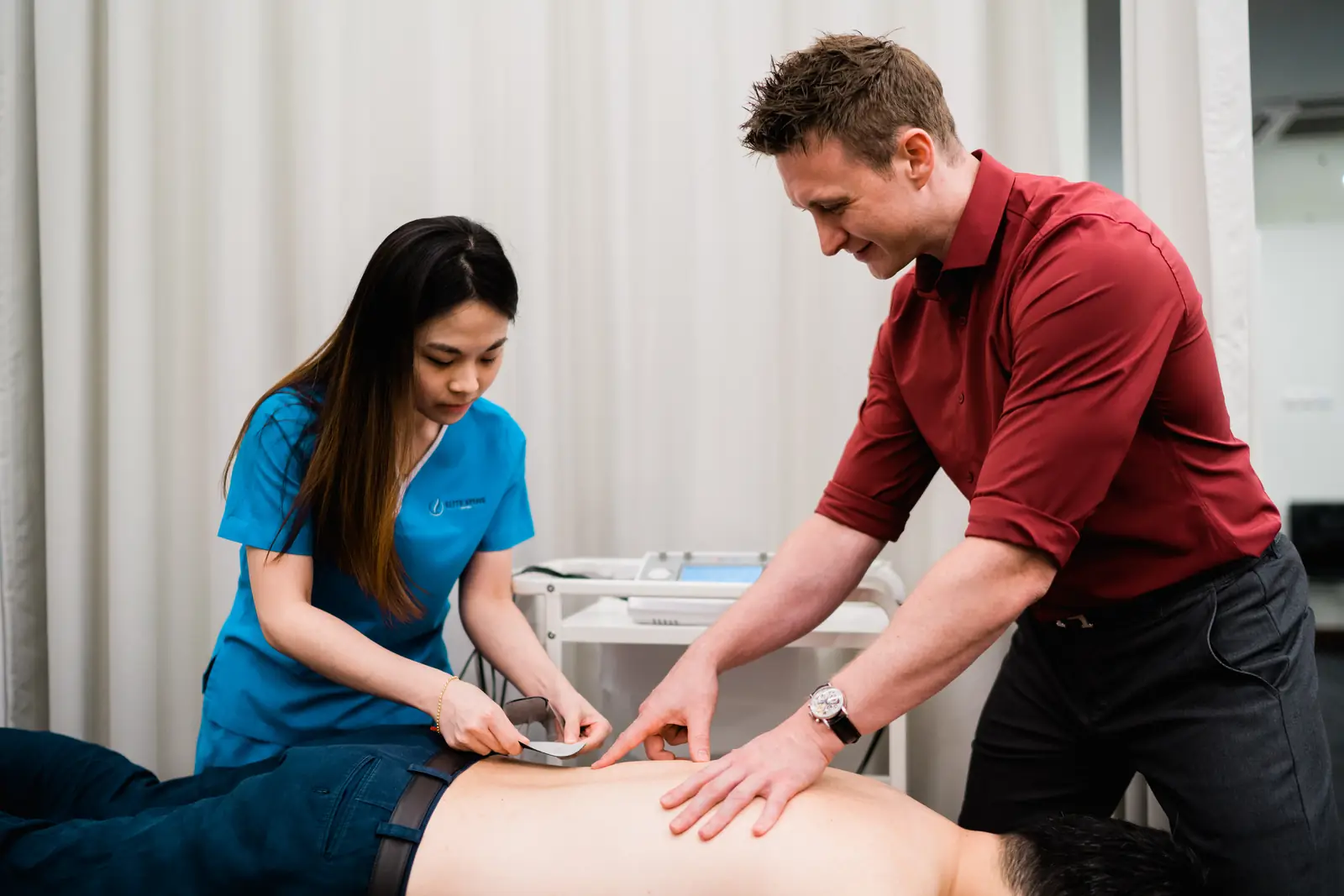
At Elite Spine Centres, posture correction is delivered through the Functional Correction Method (FCM), a multidisciplinary approach combining the best of modern chiropractic, osteopathy, physiotherapeutic machines, rehabilitative exercises and lifestyle coaching. It follows three phases. Assessment, a hands-on postural examination together with X-ray analysis, identifies which joints, muscles and daily habits are driving the postural pattern and the pain. Correction uses chiropractic adjustment and soft-tissue therapy to restore movement in stiff areas and reduce muscle tension. Reinforcement builds strength and new habits through exercise and workstation advice, so that the improvement holds without ongoing treatment.
The aim is for your own muscles to do the work a brace would otherwise do. You can read more about the approach in our guide to the Functional Correction Method, and about related problems on our neck pain and back pain pages.
Speak to the Team at Elite Spine Centres
If posture-related neck, shoulder or back pain is affecting your work or sleep, the team at Elite Spine Centres can assess what is driving it and put together a personalised treatment plan. To book a consultation, call +65 6904 8400 or message us on WhatsApp at +65 9727 3603.
Frequently Asked Questions
How long should you wear a posture corrector each day?
There is no research-based standard, and the right amount depends on your condition, your work and your daily routine. A sensible approach is to wear one for short periods as a reminder rather than all day, and to combine that brief use with strengthening exercise, which gives the device a clearer purpose.
Can a posture corrector fix a hunchback?
A corrector can pull the shoulders back while worn, but it does not change the underlying stiffness or muscle weakness behind a rounded upper back. A significant or worsening curve should be assessed by a clinician, as some causes need medical investigation.
Will a posture corrector weaken my muscles?
There is little direct research on this. What is clear is that a brace does not train your postural muscles. Relying on it all day, without exercise, leaves the underlying weakness in place.
Do posture correctors help back pain?
Evidence for pain relief from posture correctors alone is limited. A review of 41 systematic reviews found no consensus that posture causes low back pain. Movement, strengthening and treatment of stiff joints address the usual contributors more directly.
When should I see someone about posture-related pain?
If pain persists despite changes to your workstation and routine, keeps you awake, or comes with numbness, tingling or weakness in the arms or legs, have it assessed by a qualified clinician.
Sources
- Hamzelouie R et al. Effectiveness of orthotic devices in the treatment of forward head posture: a systematic review. Journal of Rehabilitation and Assistive Technologies Engineering, 2025. PubMed 40757005
- Mahmoud NF et al. The relationship between forward head posture and neck pain: a systematic review and meta-analysis. Current Reviews in Musculoskeletal Medicine, 2019. PubMed 31773477
- Swain CTV et al. No consensus on causality of spine postures or physical exposure and low back pain: a systematic review of systematic reviews. Journal of Biomechanics, 2020. PubMed 31451200
This article is for general information and does not replace a diagnosis from a qualified healthcare professional. Please consult a qualified practitioner about your individual situation.
Speak to a clinician about what is causing your pain.
Your first visit is a 60-minute session with a doctor — a full assessment and your first treatment in the same appointment. We take your clinical history, screen your posture and movement, explain what we find in plain language, and begin treatment if your condition is suitable for our care.